TWE #26: These muscles suffer the most with 50 years of ageing
Read time: 4 minutes
What’s the first thing that springs to mind when you hear "ageing"?
I’d bet many of you think of muscle loss.
Or is that just me…
The term “sarcopenia” was coined in 1989 to describe age-related muscle wasting. It literally means “a poverty of flesh” (in Greek).
Sarcopenia has a considerable impact on our health as we age. But it turns out sarcopenia affects some muscles more than others.
And this not only says a lot about WHY we lose muscle as we age - but also what we can do about it.
Let’s dive in.
A 2023 study provided new insights into how different muscles are affected by ageing
The study compiled the data from other studies comparing muscle size in younger (aged 20-29 years) and older (70-79 year) people.
In total, the review included 47 studies with a combined 982 younger and 1,003 older individuals.
Each of these studies directly compared younger and older people either at one point in time, or when followed over a period of time.
The findings of the review included 9 different muscle groups, and 3 subcomponents of 3 of these muscle groups.
So, how does sarcopenia differ between muscle groups?
Both the amount and rate (per year) of muscle loss differed widely depending on the specific muscle group studied:
Here are the results listed from most to least impacted muscle groups:
- Psoas (hip flexor; 29%, 0.58%/yr)
- Quadriceps (27%, 0.53%/yr)
- Paraspinals (deep back muscles; 24%, 0.47%/yr)
- Elbow extensors (triceps; 20%, 0.39%/yr)
- Elbow flexors (biceps; 19%, 0.38%/yr)
- Hamstrings (19%, 0.39%/yr)
- Triceps surae (calf; 14%, 0.28%/yr)
- Hip adductors (13%, 0.27%/yr)
- Dorsiflexors (9%, 0.19%/yr)
Aside from differences in muscle loss between muscle groups, there were also some notable discrepancies within muscle groups themselves.
For example, in the quadriceps muscle group, the rectus femoris decreased in size more than the other 3 quadriceps muscles (known as the vastii).
And in the hamstrings, the muscles on the medial (inner) side lost more size than the lateral (outer) hamstrings.
When looking at individual muscles (rather than muscle groups), there was more than a 5x difference in the rate of muscle loss between some muscles:
- Least: Soleus (part of the calf): -6%, -0.13%/yr
- Most: Rectus femoris (part of the quadriceps): -33%, -0.66%/yr
What explains these muscle-specific differences?
There are a few possibilities, but the main ones include:
- Changes in muscle activity
- Timeline of the aging process
- Muscle fibre type (proportion of ‘fast’ versus ‘slow’ muscle fibres in a given muscle)
Of these, changes in muscle activity were identified as the likely main culprit.
But why?
Well, we know even short-term inactivity has disastrous consequences for muscle.
To give you an idea, one study found two months of bed rest reduced the size of the thigh muscles by more than half of that lost in 50 years of ageing.
The pattern of muscle-specific losses observed also provided some clues as to the role of inactivity.
Some of the muscles that experienced the most loss over 50 years of ageing are CRITICAL for movement and activities of daily living.
These muscles included those of the thigh and hip (quadriceps, hamstrings, adductors, abductors, hip flexors) and lower leg (the calf muscles gastrocnemius and soleus).
Think of common daily movements such as walking, rising from a chair, climbing stairs.
These movements require us to:
- Extend our knees: requires the quadriceps
- Lift our knees (or ‘flex’ at the hip): requires the hip flexors
- Stabilise on one leg: requires the hip abductors/adductors, lower-leg muscles
So if we’re doing less daily activities (such as the examples mentioned), these muscles just aren’t forced to work as much.
And when this happens, muscle loss quickly ensues.
As the old addage goes: “Use or it lose it”.
Muscle loss has significant consequences for our overall health and risk of negative outcomes.
Muscle plays a critical, yet underappreciated, role in our overall health.
We often think muscle is just there to allow us to move - but it also plays a key role in both the storage and use of energy sources (such as glucose and amino acids) in the body.
Muscle loss of course contributes to declines in aspects of muscle function, like strength and power, which are not only critical for daily tasks but can predict our risk of adverse outcomes.
For example, low muscle strength of the quadriceps in particular is linked to increased falls risk.
And, because most falls leading to hip fracture occur when the hip is impacted when falling in the lateral direction, declines in the function of the hip adductor and abductor muscles increase fall and fracture risk.
What’s more, dysfunction of the lower-leg muscles (such as the calf and dorsiflexors) impairs mobility and increases falls risk by reducing the ability to lift the front part of the foot (known as foot drop) when walking.
Again, all of these muscle groups are the ones most susceptible to sarcopenia.
Clearly it's important to address these losses - but the next question is how.
Resistance training is the most effective tool we have for slowing muscle loss.
No surprises there.
But it’s good to remind ourselves that even low doses of resistance training can be effective.
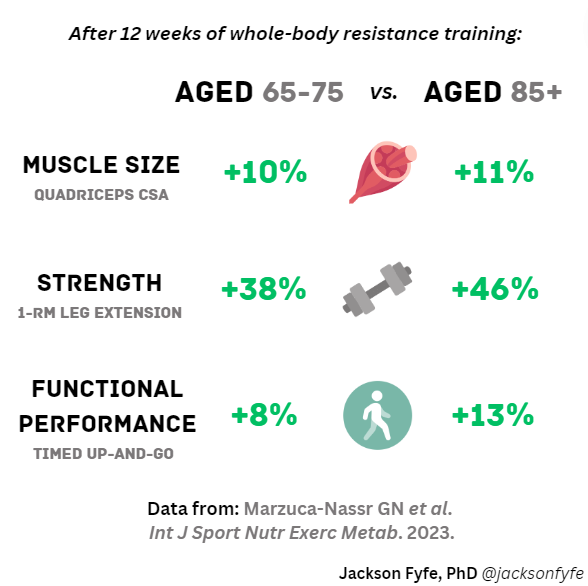
For example, after 12 weeks of resistance training (3 days per week), older men who did just 1 session per week maintained their muscle mass and strength over the next 6 months.
And, it’s never too late to start - take this recent study for example:
|

Resistance training can also counter the effects of inactivity on muscle.
During 3 months of bed rest, performing 4 sets of squats and calf press every third day prevented the loss of quadriceps muscle size and strength.
A little resistance training really does go a long way.
The fact that sarcopenia is most prominent in the muscles we need most for daily activities speaks volumes.
The less we use our muscles, the more we lose them.
And in turn, the harder it is to keep doing our daily activities.
Muscle loss begins sooner than many think (as early as our 30's).
But the good news is muscle is very forgiving and can still respond positively to exercise - even after decades of neglect.
So while it’s best to act early, it’s never too late to start.
Thanks for reading!
Until next week,
Jackson
If you've got a moment, I'd love to hear your thoughts on this edition of The Weekly Exerciser.
Send me a quick message or email - I'll reply to every one!
PS: Did someone forward you this email? You can sign up to The Weekly Exerciser here.
IMPORTANT:
The information contained herein is of general nature only and does not constitute personal advice. You should not act on any information without considering your personal needs, circumstances, and objectives. Any exercise program may result in injury. We recommend you obtain advice specific to your circumstances from an appropriate health professional before starting any exercise program.
The Weekly Exerciser
A weekly newsletter with actionable tips to make exercise easier.